
The new Pajero is a seven-seat body-on-frame SUV built on the Triton pickup’s chassis, with a 2.4-liter diesel (201 hp, 354 lb-ft), an 8-speed automatic and Super Select 4WD-II. Mitsubishi is aiming squarely at the Land Cruiser Prado 250 — and on paper it nearly lands the punch: the same footprint, more ground clearance, a price 5–8% lower and a third row adults can actually use. The Land Cruiser answers with torque, permanent four-wheel drive, a proven 2.8-liter engine and resale nobody argues with. Whether the Pajero comes back to the US as the Montero is still undecided.

Five years ago the Pajero quietly left the assembly line, and it looked like for good: Mitsubishi had pivoted to crossovers, and the nameplate with twelve Dakar wins was left to the greatest-off-roaders lists. In September 2026 the name came back — not on a soft-roader, but on an honest body-on-frame SUV with a low range. Americans remember it as the Montero, sold here until 2006. Below is everything Mitsubishi has officially said about the fifth generation, the first prices in Japan and Australia, a detailed comparison with the Land Cruiser Prado 250, where the new Pajero sits next to the LC300, the Ford Everest and the US-market Land Cruiser — and a sober look at whether it will ever reach a US showroom.
The Pajero is back: what Mitsubishi showed on September 2#
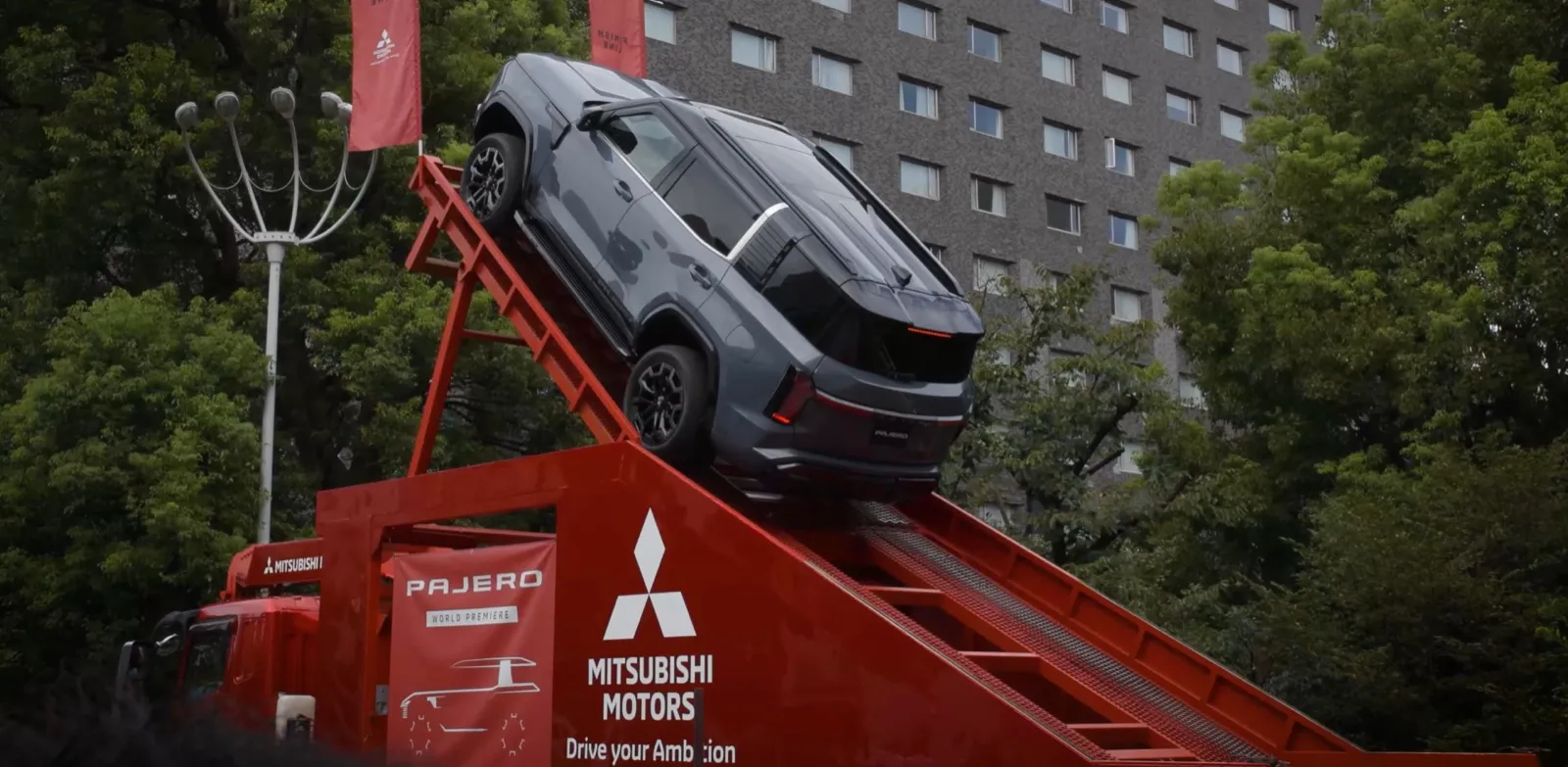
The world premiere took place in Tokyo on September 2, 2026. This is the fifth generation of the model, after the Pajeros of 1982, 1991, 1999 and 2006. The fourth generation left the Japanese line back in 2019 and export production ended in 2021; since then the name lived on only in the Pajero Sport. The new Pajero is built in Thailand, and Mitsubishi has laid out the rollout by fiscal year:
- Thailand is the first market in the world. According to the Thai press, prices will be announced on October 19, when sales begin.
- Japan and Australia follow before the end of fiscal 2026 (that is, by March 2027). Australian deliveries start in December; in Japan the official announcement is set for October 29, and according to the Japanese press deliveries of some grades will stretch into spring 2027.
- About 100 countries from fiscal 2027: Southeast Asia, Latin America and the Middle East.
The key engineering decision is a separate ladder frame. The third- and fourth-generation Pajeros used a unibody with a frame built into it, which made them comfortable on pavement but not the toughest machines on hard trails. The new Pajero rides on the frame of the latest Triton pickup (the L200 in some markets), but gets its own five-link coil-sprung rear suspension instead of the pickup’s leaf springs. The positioning is new too: this is the brand’s flagship, sitting above the Pajero Sport, and the rivals are named in plain sight — the Toyota Land Cruiser Prado and the Ford Everest. Demand looks real, at least in Australia, where more than 3,000 pre-orders came in before the car was even revealed.
Engine, transmission and four-wheel drive#
There is one engine for every market: a 2.4-liter 4N16 turbodiesel with a single variable-geometry turbo and AdBlue (DEF) aftertreatment, rated at 150 kW (201 hp; Mitsubishi quotes 204 PS) at 3,500 rpm and 480 Nm (354 lb-ft) from 1,750 to 2,500 rpm; some market specifications cap torque at 470 Nm (347 lb-ft). You will see the new Pajero described as a “twin-turbo diesel” online — that is a mix-up with the Triton, whose top version of the same engine really does have two turbos. According to Mitsubishi, the Pajero has one. There is no gasoline version, and the plug-in hybrid rumored before the premiere was not confirmed.
The transmission is a new 8-speed automatic in place of the Triton’s six-speed. Early drives praise it more than anything else: at about 87 mph the engine turns roughly 2,000 rpm in eighth, and the shifts are noticeably smoother. Drive goes through Super Select 4WD-II, the Pajero’s signature in every generation:
- 2H — rear-wheel drive for dry pavement: lower losses, better mileage;
- 4H — full-time four-wheel drive through a center differential, on any surface at any speed;
- 4HLc — center differential locked for mud, sand and snow;
- 4LLc — low range with the center locked for serious off-roading.
On top of that come a rear differential lock (not on every trim — more on that below), seven drive modes (Normal, Eco, Gravel, Snow, Mud, Sand, Rock) and S-AWC, a system that brakes individual wheels to shift traction between the left and right sides (Active Yaw Control) and help the car turn. The Prado’s four-wheel drive is permanent — it has no 2H mode to save fuel on dry roads.
Body, geometry and cabin#
The Pajero measures 193.7 × 75.8 × 75.2 in (4,920 × 1,925 × 1,910 mm) on a 113.0-in (2,870 mm) wheelbase. Ground clearance is 9.1 in (230 mm), approach, breakover and departure angles are 30.4°, 22.6° and 25.8°, and weight is split 52:48 front to rear. The Australian Exceed weighs 5,254 lb (2,383 kg), tows up to 7,716 lb (3,500 kg) and carries a 21.1-gallon (80 L) fuel tank.
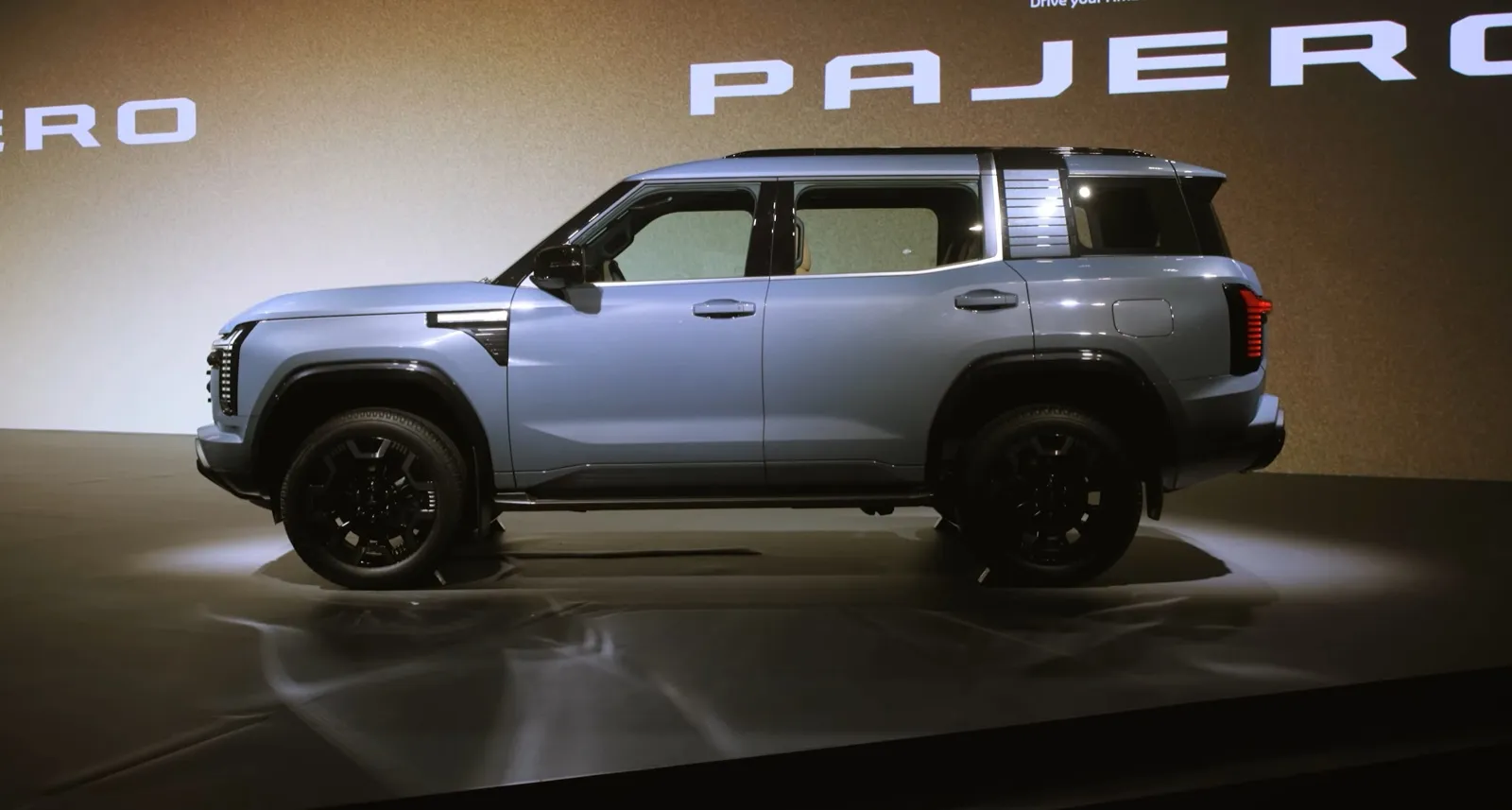

Inside there are three rows and seven seats (in Australia the base GLS also comes as a five-seater). The second row slides, and that matters more than it sounds: the Japanese outlet MOTA, which measured the seating, says six adults can ride in a Pajero for 45 minutes without complaint — in the Prado the fixed second row squeezes the third almost to the floor. The flip side is cargo space: with the third row up it is token, and in the Australian comparison by carsales the Pajero’s quoted cargo volume is noticeably smaller than the Prado’s and the Everest’s.
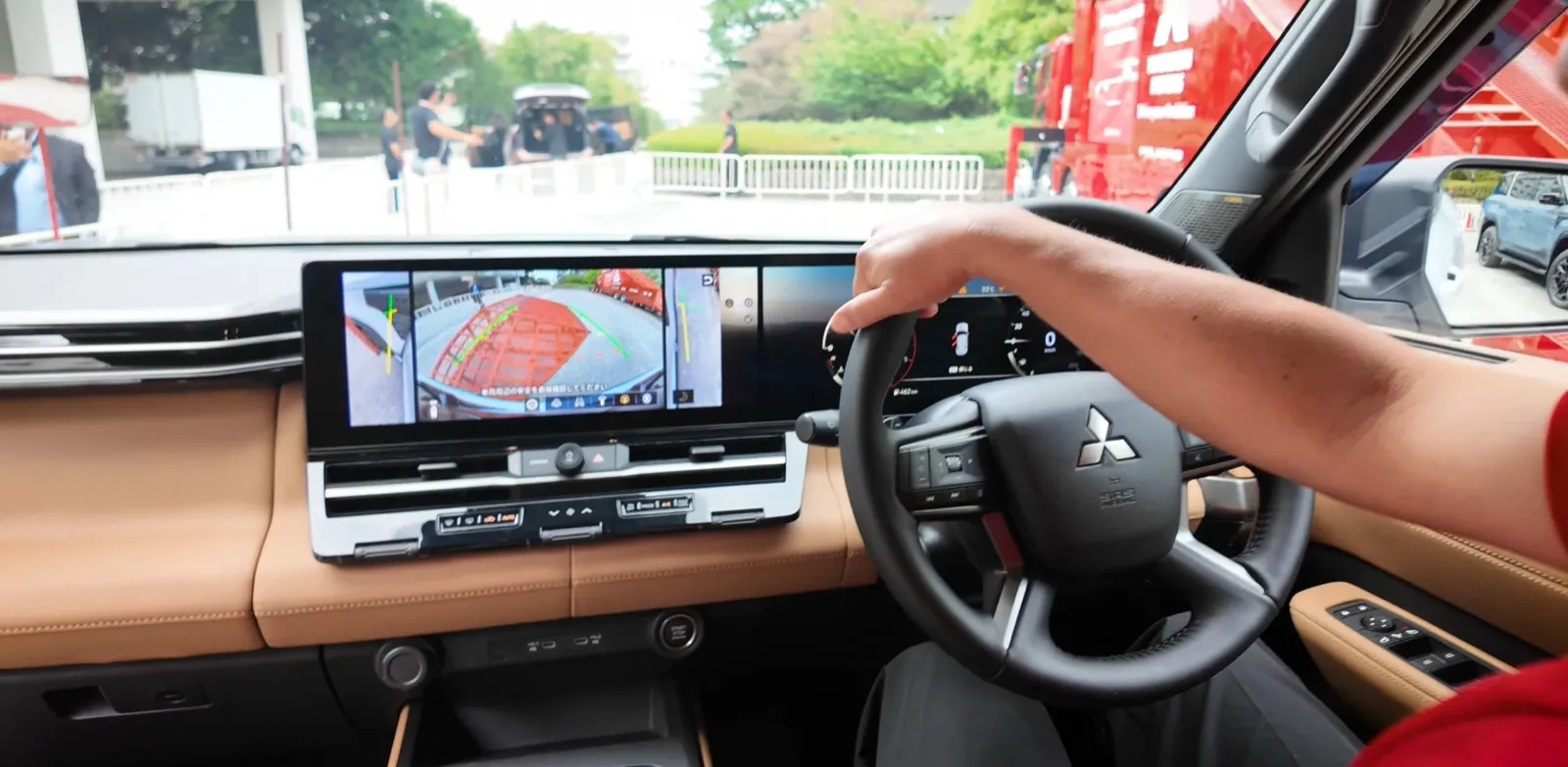
The equipment is a level Mitsubishi has never offered before: a single 14.3-inch display panel (12.3 inches on base trims), three-zone climate control, a 12-speaker Yamaha audio system, eight airbags including a center airbag between the front seats, MI-PILOT adaptive cruise with lane keeping, and surround-view cameras with an under-floor view — in effect a “transparent hood” for the trail.

First impressions from behind the wheel come only from Mitsubishi’s proving ground in Okazaki, Japan, where journalists drove production cars. Australia’s CarsGuide praises the quiet ride at speed, the composure in corners for a vehicle this heavy and “the plushest Mitsubishi interior to date” — but flags the key point: the Pajero could use more torque, and off the line it feels heavier and lazier than its rivals. Off-road ability was not tested at all.
Prices: Japan and Australia#
In Japan, according to MOTA, the lineup has four grades, all with the diesel, four-wheel drive and seven seats:
| Grade (Japan) | Price | What matters |
|---|---|---|
| GLS | ¥6,193,000 | base, 12.3-inch screen |
| GSR | ¥6,765,000 | leather, 14.3-inch screen, rear differential lock |
| Exceed | ¥6,930,000 | pricier than GSR, but 12.3-inch screen and no locker |
| Super Exceed | ¥7,950,800 | fully loaded |
Prices per Japan’s MOTA (September 2026); the official Japanese announcement is due October 29.
Note the trap: in the Japanese lineup the Exceed costs more than the GSR but loses the rear differential lock — for anyone buying a Pajero for the trail, that matters more than leather and screens. Same-named trims are built differently from market to market (in Australia, for instance, the GSR is the most expensive), so judge a Pajero by its option list, not its badge.
Australian prices are already out: from A$68,490 for the five-seat GLS to A$84,990 for the GSR, against A$73,200–101,365 for the Prado. Mitsubishi Australia adds a 10-year or 200,000-km (124,000-mile) warranty, conditional on dealer servicing, and 15,000-km (9,300-mile) service intervals — the Prado there needs a visit every 10,000 km (6,200 miles) or six months.
Pajero vs Land Cruiser Prado 250: the spec table#
This is the main event. The Prado 250 is also body-on-frame, also seats seven and is also fresh (2023), so the comparison is fair: two new generations, two four-cylinder turbodiesels, one class. The table uses the diesel Prado sold worldwide — the US gets a hybrid, covered below.
| Spec | Mitsubishi Pajero (2026) | Land Cruiser Prado 250 (diesel) |
|---|---|---|
| Diesel engine | 2.4L turbo (4N16) | 2.8L turbo (1GD-FTV) |
| Power / torque | 201 hp / 354 lb-ft | 201 hp / 369 lb-ft |
| Transmission | 8-speed automatic | 8-speed automatic |
| Four-wheel drive | Super Select: 2H / 4H / 4HLc / 4LLc | permanent, center lock |
| Length / width / height | 193.7 / 75.8 / 75.2 in | 193.9 / 78.0 / 75.8–76.2 in |
| Wheelbase | 113.0 in (2,870 mm) | 112.2 in (2,850 mm) |
| Ground clearance | 9.1 in (230 mm) | 8.3–8.9 in (210–225 mm) |
| Curb weight (Australia) | 5,254 lb (2,383 kg) | 5,578 lb (2,530 kg) |
| Towing (Australia) | 7,716 lb (3,500 kg) | 7,716 lb (3,500 kg) |
| Fuel tank (Australia) | 21.1 gal (80 L) | 29.1 gal (110 L) |
| Economy, Japan WLTC | 12.1 km/L ≈ 28.5 mpg* | 11.0 km/L ≈ 25.9 mpg |
| Price in Japan | ¥6.19–7.95M | ¥5.20–7.35M (diesel) |
| Price in Australia | A$68,490–84,990 | A$73,200–101,365 |
* Provisional figure. WLTC is Japan’s test cycle, not the EPA’s — EPA ratings for diesels this size come out lower. Japanese Prado prices are the 2024 launch prices. The Prado’s clearance and height vary by market and tires; the Australian Prado is a 48-volt mild hybrid rated at 7.6 L/100 km on the ADR cycle. The Prado is also sold with gasoline engines; the Pajero is not.
The Land Cruiser you can actually buy in the US is the same 250 Series, but with only one powertrain: the i-FORCE MAX hybrid — a 2.4-liter turbo four plus an electric motor, 326 hp and 465 lb-ft, full-time 4WD and EPA ratings of 22 city, 25 highway and 23 mpg combined. The 2026 model starts at $57,200 for the 1958 grade and $63,275 for the Land Cruiser grade. Next to it, a 201-hp diesel Pajero would be the slower, more frugal tourer — and a hard sell on a US spec sheet.
Who wins where: point by point#
Where the Pajero is stronger:
- Price. On comparable trims the Pajero is roughly 5–8% cheaper in both Japan and Australia: the Japanese Exceed costs ¥6.93 million against ¥7.35 million for a diesel Prado ZX, and the Australian base model is A$68,490 against A$73,200.
- Geometry and size. 9.1 in of clearance against 8.3–8.9, and a body 2.2 in narrower — on wooded trails and in ruts you feel it.
- Third row. The sliding second row makes the Pajero a genuine seven-seater; the Prado is honestly comfortable only with five aboard.
- Drivetrain on pavement. The Prado has no 2H mode, and S-AWC adds stability on slippery roads: better mileage around town, more confidence in winter.
- Rated economy. About 9% better on Japan’s WLTC cycle — although the Pajero’s figure is still provisional.
Where the Prado is stronger:
- Pulling power. 369 lb-ft from 2.8 liters against 354 from 2.4 — and the first drives of the Pajero confirm it: fully loaded or with a trailer, the gap will feel bigger than the table suggests.
- A proven engine. The 1GD-FTV has powered the Prado and Hilux since 2015: its teething troubles (a temperamental particulate filter in the early years) are long understood, and mechanics know it inside out. The 4N16 has so far worked mainly in the Triton pickup — how it copes with a new automatic in a 5,250-lb SUV only the first years will show.
- Range. The Australian Prado’s 29-gallon tank gives nearly 900 miles on paper — the Pajero, with 21 gallons, cannot get close.
- Articulation. The SDM front stabilizer disconnect on upper Prado trims gives the front axle more travel off-road.
- Resale and support. A Land Cruiser holds its value like few vehicles on earth, and every Toyota dealer can service it. The Pajero is coming back after a five-year break — how it holds value nobody knows yet.
It is too early to judge either for reliability: the Prado 250 has been on sale for three years, the Pajero has not reached its first owners. The documented weak spots of earlier generations — diesel injectors and EGR, the 4M41 timing-chain guides on the old Pajero, the cracked pistons of early 1KD Prados — are collected on the Mitsubishi Pajero and Land Cruiser Prado pages of our knowledge base.
What about the “real” Land Cruiser 300?#
Outside North America, “Land Cruiser” often means the big Land Cruiser 300 rather than the Prado. The new Pajero does not compete with it — that is another class. The LC300 runs V6 engines: a 3.3-liter twin-turbo diesel (around 300 hp and 516 lb-ft) or a 3.5-liter twin-turbo gasoline V6 with 409 hp, through a ten-speed automatic. It is not sold in the US at all; its American sibling is the Lexus LX. The LC300’s real rival is the Nissan Patrol (sold in the US as the Armada), not the Pajero: Mitsubishi has offered nothing that size with a V6 since the Pajero IV and its 3.8.
Measured against the LC300 in spirit, the Pajero has one argument — cost of ownership. A four-cylinder diesel, less weight and an everyday 2H mode cost noticeably less in fuel, tires and insurance than a 300-plus-horsepower V6. How those lines add up per mile is the subject of our guide to the true cost of car ownership.
The other rivals: Everest, Pajero Sport and the US body-on-frame crowd#
- Ford Everest — the toughest rival in Asia and Australia. A 3.0-liter V6 diesel with 600 Nm (443 lb-ft), a ten-speed automatic, 31.5 in of wading depth and a lower starting price than the Pajero (from A$58,990). It is not sold in the US either — Ford fills that slot here with the Bronco.
- Pajero Sport — the younger sibling, which is not going away. It rides on the previous-generation Triton platform with a 181-hp 2.4 diesel and costs less than the new Pajero. It was never sold in the US. The new Pajero does not replace it; it sits on top.
- Toyota 4Runner, Ford Bronco, Jeep Wrangler — the body-on-frame SUVs an American shopper can actually buy. None is a three-row diesel tourer like the Pajero, which is precisely the niche a US Montero would have to argue for.
Will the new Pajero come to the US?#
Not decided — and the official plan does not include North America. Mitsubishi’s rollout list names Thailand first, then Japan and Australia, then about 100 countries from fiscal 2027 across Southeast Asia, Latin America and the Middle East. What makes the US case interesting:
- Dealers have seen it. At a private product preview near Chicago in June 2026, Mitsubishi walked US and Canadian retailers through the new Pajero as the next Montero, according to Carscoops.
- The company has not committed. Mitsubishi Motors North America says no decision has been made on a US introduction.
- The engine is the obstacle. The only powertrain is a diesel, and Mitsubishi sells no diesels in the US. A US Montero would need either a different powertrain or a US certification of this one — and against a 326-hp hybrid Land Cruiser, 201 hp would be a tough number to put on a window sticker.
- Left-hand drive comes later. Thailand, Japan and Australia drive on the left, so the first cars built are right-hand drive; left-hand-drive production follows the fiscal 2027 rollout to the Middle East and Latin America.
What to watch on the first cars#
- Recalls. The first years of any new model bring recalls: the Prado 250, for example, had campaigns for an instrument cluster that could fail to show warning lights at start-up and for a surround-view camera image that could freeze. Expect the Pajero to go through the same.
- The particulate filter and AdBlue. A modern diesel with SCR aftertreatment does not like a life of short trips: on the Pajero Sport’s 4N15, from the previous engine series, a clogged particulate filter and fuel-diluted oil are among the most common complaints. If the car will only do errands around town, ask honestly whether you need a diesel at all — and keep the AdBlue (DEF) topped up.
- The option list, not the badge. The rear locker, screen size and even the number of seats vary by market — check the equipment of the actual car.
- Your own real economy from the first tank. Until a new model has owner data, your own number is the best health sensor: a sudden rise in a diesel’s consumption is often the first symptom of trouble with the particulate filter or injectors. How to measure it honestly is covered in our guide on how to calculate gas mileage.
Frequently asked questions#
When does the new Mitsubishi Pajero go on sale?
Thailand is the first market in the world, with sales starting in fall 2026. Japan and Australia follow before the end of Mitsubishi’s fiscal 2026 (March 2027), and from fiscal 2027 the Pajero rolls out to about 100 countries across Southeast Asia, Latin America and the Middle East. North America is not on that list yet.
What engine does the new Pajero have?
Just one: a 2.4-liter 4N16 turbodiesel with a single variable-geometry turbo, rated at 150 kW (201 hp) and 480 Nm (354 lb-ft) — 470 Nm in some markets — with a new 8-speed automatic and AdBlue (DEF) exhaust treatment. Mitsubishi has announced no gasoline or hybrid version.
Is the new Pajero coming to the US as the Montero?
Not decided. Mitsubishi previewed the new car to US and Canadian dealers as the next Montero in June 2026, but Mitsubishi Motors North America says no decision has been made on a US introduction. The only engine is a diesel, and Mitsubishi sells no diesels in the US.
Is the new Pajero the same as the Pajero Sport?
No. The Pajero Sport stays on sale in its markets as a separate, cheaper model. The new Pajero sits above it as the brand’s flagship: a newer frame from the latest Triton pickup, seven seats, S-AWC and a far more upscale cabin.
Which is better, the new Pajero or the Land Cruiser Prado 250?
The Pajero costs less on comparable trims, has more ground clearance (9.1 in versus 8.3–8.9), is narrower, and its sliding second row makes the third row usable for adults. The diesel Prado pulls harder (369 versus 354 lb-ft), has permanent four-wheel drive, a proven 2.8-liter engine and far stronger resale. For a seven-seat family hauler the Pajero makes more sense on paper; for towing, expeditions and resale the Land Cruiser is the safer bet.
How does the Pajero compare with the Land Cruiser sold in the US?
The US Land Cruiser is the same 250 Series, but sold only as the i-FORCE MAX hybrid: 326 hp and 465 lb-ft, EPA 23 mpg combined, from $57,200. Next to it the 201-hp diesel Pajero would be clearly slower — which is one more reason a US version would need a different powertrain.
What real-world fuel economy will the new Pajero get?
Its provisional Japanese WLTC rating is 12.1 km/L, about 28.5 mpg — but that is not an EPA number, and EPA tests come out lower. Owners have no data yet; body-on-frame diesels typically use 15–30% more fuel than the lab figure in real driving, which points to roughly 21–25 mpg in mixed use.
How much does the new Pajero cost?
In Japan it runs from ¥6,193,000 to ¥7,950,800 according to the Japanese outlet MOTA; in Australia from A$68,490 to A$84,990 before on-road costs. On comparable trims that is roughly 5–8% less than a diesel Land Cruiser Prado 250 in both markets.
The verdict: who should pick the Pajero, who the Land Cruiser#
The new Pajero is not a nostalgia project but a precisely aimed answer to the Prado 250: the same footprint, more clearance, a usable third row, the signature Super Select with a 2H mode, and a price a few percent lower. If you need a seven-seat body-on-frame SUV for family trips and long distances, the Pajero is the more rational choice on paper. If pulling power with a trailer, a long-proven engine, a dealer in every town and resale value matter more, the Land Cruiser is still the safer bet — and in the US it is, for now, the only one of the two you can buy. The final verdict will come not from spec tables but from the first two years in owners’ hands.
Whatever body-on-frame SUV you choose, Brimly helps keep it in check: it computes your real mpg between full fill-ups, keeps the service history and reminds you about maintenance by mileage. And if you want to know what a specific vehicle will cost you, ask the free AI assistant: the service schedules and known weak spots of the Land Cruiser, the Prado and earlier Pajeros are in its verified knowledge base.