
The average new car in America costs $12,863 a year to own — about 86 cents for every mile it drives (AAA, Your Driving Costs 2026, 15,000 miles a year). The biggest line is not gas: it is depreciation, $4,422 a year, a third of the bill, followed by insurance at $2,098. A paid-off mainstream car kept long and driven a lot comes in at 45–60 cents a mile; a half-ton pickup at $1.10. Below: where every dollar goes, how to compute the figure for your own car, and a calculator that does it.


Ask a driver what their car costs and they will tell you about gas — the one line that shows up on a receipt every week. Ask an accountant and they will tell you about the line that never shows up on any receipt: the $350 a month the car quietly sheds in value while it sits in the driveway. This article puts the two together with the four other lines, using AAA’s 2026 Your Driving Costs study, iSeeCars’ depreciation data and the insurance trackers as the national baseline, and then shows how to build the same figure for your own car — because the national average is a fine benchmark and a useless budget. By the end you will know what a mile costs you, which lines you can actually move, and why the car that costs the most per mile in most households is the one that drives the least.
The national baseline: $12,863 a year, 86¢ a mile#
Every September AAA prices the ownership of the best-selling new vehicles over five years and 75,000 miles, assuming a five-year loan with 15% down, full-coverage insurance and the manufacturer’s maintenance schedule. The 2026 edition lands at $12,863 a year, or $1,072 a month, on an average sticker of $39,376 — and the study is honest that the number covers a new car financed the way most Americans finance one. The shape of the bill matters more than the total:
Two things jump out. The single largest line is one that never appears on a bank statement until the day you sell. And the two lines people argue about most — gas and repairs — sit inside the block that is smaller than depreciation plus insurance. Which is why the advice that saves real money is rarely about driving gently.
The six lines of the bill#
1. Depreciation — the biggest line, and the one nobody sees
A new car loses about 42% of its value in five years — iSeeCars’ 2026 study of 950,000 five-year-old cars, inflation-adjusted. On today’s average new-car transaction price of $50,089 that is roughly $21,000, or $4,200 a year, almost exactly the $4,422 AAA counts. The spread by segment is wide: pickups lose 34%, hybrids 35%, luxury cars 48% and electric cars 57%. Depreciation is also front-loaded — the first year takes the biggest bite, years four to eight the smallest — which is the whole case for the used car we come back to below. You cannot see this line in a monthly budget, but it is the reason a $50,000 car and a $30,000 car with the same gas mileage are $600 a month apart.
2. Fuel — the line everyone tracks
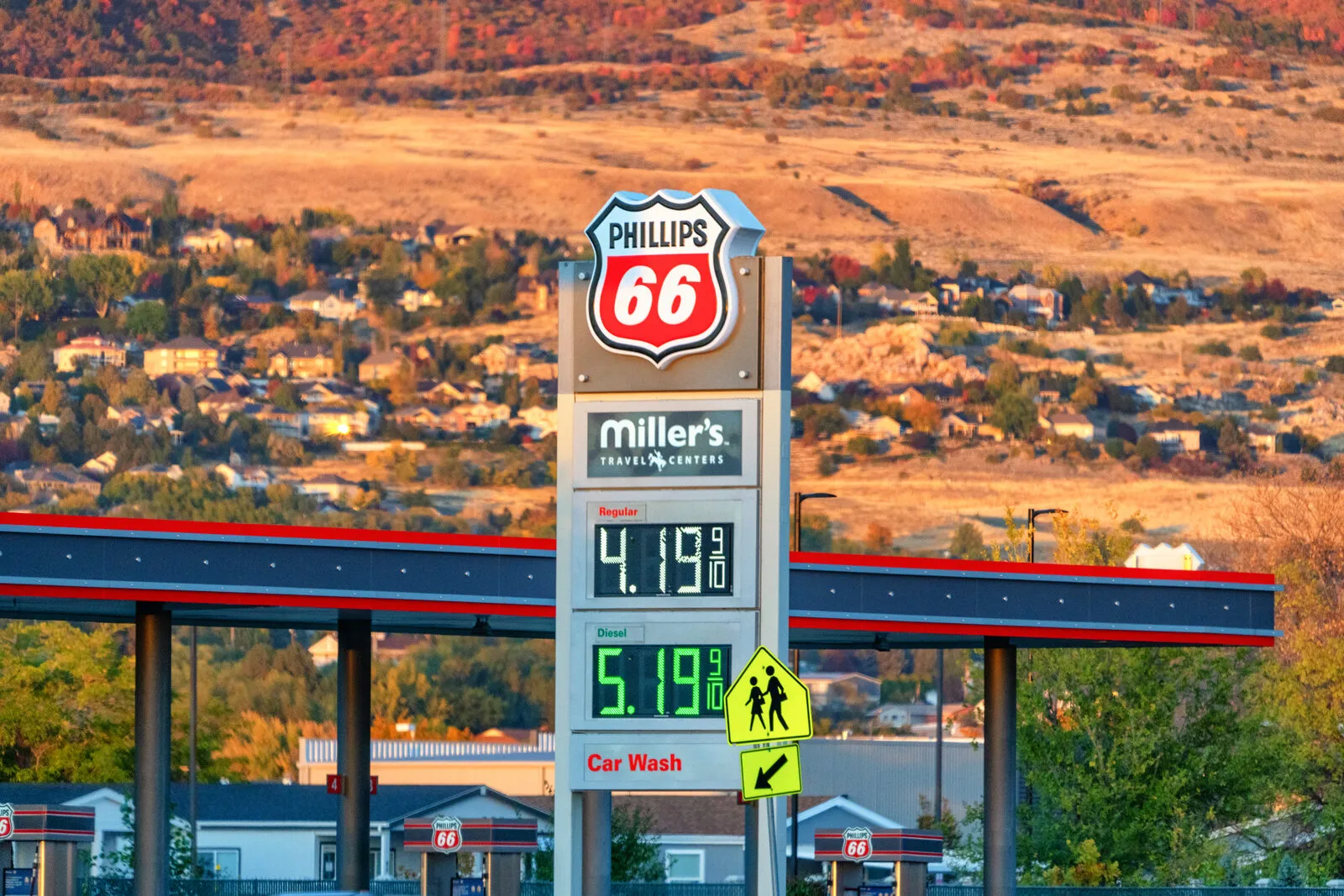
Fuel is the most visible line and the easiest to compute honestly: miles divided by your real mpg, times the price. At AAA’s $4.15 a gallon and 15,000 miles, a car that truly does 30 mpg costs $2,075 a year in gas; a 20 mpg pickup costs $3,112; a 45 mpg hybrid $1,383. The mistake is to use the window-sticker mpg — the real figure is typically 10–15% worse, and we showed how to measure it with two full tanks. Fuel is also the line that responds fastest to behaviour: speed, short trips and tire pressure move it by 10–20% without touching the car.

3. Insurance — the fastest-rising line
AAA carries $2,098 a year for full coverage; the trackers that survey real quotes run higher — Bankrate at $2,638, NerdWallet around $2,300 — and every one of them recorded a double-digit rise in a year, driven by repair costs and the price of the cars being insured. The variation is the largest of any line: the same coverage is about $1,150 a year in Wyoming and $4,500 in Louisiana, and within a state a clean record, a higher deductible and an annual re-quote move it by hundreds. On a paid-off ten-year-old car the question of dropping collision coverage is worth asking every renewal.
4. Maintenance, repairs and tires — the line that grows with age
AAA’s methodology carries about 11 cents a mile — roughly $1,650 a year at 15,000 miles — for scheduled maintenance, an allowance for repairs and one set of tires over five years. That is a new-car figure. CarEdge’s data puts maintenance at about 1.5 times that for a car aged four to seven, 2.2 times at eight to eleven and 2.8 times past twelve — and the brand matters as much as the age: a ten-year-old Toyota Corolla averages $656 a year, a ten-year-old Jaguar F-PACE $2,601. Tires are the piece people forget: a mid-range set in a common size is $400–600 and lasts about 25,000 miles (roughly 40,000 km in ADAC’s tests), so budget about 2 cents a mile for rubber alone. The maintenance-by-mileage checklist is the schedule this line should follow — and our guide to spotting an inflated estimate is how it stays there.

5. Registration, taxes and inspections
The smallest line and the most local. Registration renewal runs from under $50 a year in some states to several hundred in others; a handful of states add an annual property tax on the car’s value that can reach $1,000 on a new vehicle; some counties require an emissions or safety inspection at $20–70. AAA folds these into the remainder. They are worth knowing for one reason: when you compare two cars, the taxes on a $50,000 truck and a $30,000 sedan differ by hundreds in the states that tax value.
6. Finance charges, parking, tolls — the lines nobody counts
AAA counts $1,184 a year in interest on the average loan — a line that exists only because of how the car was bought, and that disappears entirely with a bigger down payment or a cheaper car. Then the lines that never make it into anyone’s mental budget: a downtown parking permit, tolls on the commute, the car wash, the roadside membership. Individually small, together they are often $500–1,500 a year — more than the tires. The only way to see them is to log them.

_(1).jpg)
Comparison: what a mile costs by vehicle type#
| Vehicle (AAA 2026, 15,000 mi/yr) | Per year | Per mile | What drives it |
|---|---|---|---|
| Small sedan | ≈ $9,300 | ≈ 62¢ | Low price, low depreciation, 35+ mpg |
| Medium sedan, gas | $10,582 | 71¢ | The mainstream reference point |
| Average new vehicle | $12,863 | 86¢ | Includes the loan: $1,184 in interest |
| Medium sedan, electric | $13,662 | 91¢ | Energy 66–70% cheaper per mile; depreciation about double |
| Half-ton pickup | ≈ $16,500 | $1.10 | Price, 20 mpg, tires and insurance on a $60,000 truck |
AAA Your Driving Costs 2026. Per-mile figures are annual cost ÷ 15,000; the small-sedan and pickup annual totals are derived from AAA’s per-mile figures. New vehicles, five-year financed ownership.
How to cost your own car per mile#
The national figure is a benchmark. Your figure comes from six numbers you already have, or can get in an evening:
- Depreciation: what you paid, minus what the car will be worth when you sell, divided by the years you will keep it. For the resale value, look up your car’s model three or five years older on any used-car site — that is the future you.
- Fuel: your annual miles (the odometer, or the difference between two registration renewals) divided by your real mpg, times the price you actually pay. The fill-up log has all three.
- Insurance: the annual premium from the policy, not the monthly you remember.
- Maintenance and tires: last year’s receipts, or the schedule’s items for the coming year plus a fifth of a set of tires. Add 20% for the unplanned.
- Taxes and fees: the registration renewal, the inspection, any property tax on the car.
- Everything else: parking, tolls, washes and the interest on the loan for the year. Look at a card statement for one month and multiply by twelve.
Add them, divide by the miles. The calculator below does the arithmetic and shows which line dominates; it is prefilled with a realistic compact SUV so you can see what a “normal” bill looks like before replacing the numbers with yours.
What your car costs per mile
- Cost per mile
- $0.61
- Per month
- $764
- Per year
- $9,165
Prefilled with a $34,000 compact SUV kept five years at 15,000 miles a year, resold at 58% of its price (the iSeeCars 2026 average), 30 mpg real, $4.15 gas. Replace every number with your own; nothing is stored.
Fixed versus variable: why the car that sits costs the most#
Split the bill by what changes when you drive an extra mile. Fuel, tires and part of maintenance are variable — perhaps 20–25 cents a mile on a mainstream car. Depreciation by age, insurance, registration, parking and interest are fixed — close to $6,000 a year on the compact SUV above whether it moves or not. Divide that fixed block by the miles and the arithmetic is brutal: at 15,000 miles it adds about 39 cents to every mile; at 5,000 miles, about $1.18. The second car that mostly sits in the driveway is usually the most expensive vehicle a household owns per mile, and a ride-share account or a weekend rental is often cheaper than keeping it insured and depreciating. Past about 20,000 miles a year the curve flattens again, because mileage starts to feed depreciation and maintenance.
Used versus new: where the curve bottoms out#
Because depreciation is front-loaded and maintenance is back-loaded, the two curves cross. Years zero to three carry the steepest depreciation and the lowest repairs; years twelve and up carry almost no depreciation and about 2.8 times the maintenance. In between, roughly years three to eight, a mainstream car is at its cheapest per mile: the first owner has paid for the steep part of the curve, insurance is lower on a cheaper car, and repairs are still about 1.5 times new. The exception that proves the rule is the Corolla-class car whose repairs never get expensive — for it, the cheapest strategy is to keep driving. Our list of the most reliable cars in the US is, read this way, a list of cars whose maintenance line stays flat.
Electric, hybrid or gas: which costs less per mile?#
Three honest data points, and they do not agree, because they measure different things. AAA, US, full ownership: a medium electric sedan costs $13,662 a year against $10,582 for the gas equivalent — $3,080 more — because its depreciation is roughly double, even though home charging is 66–70% cheaper per mile than gasoline; hybrids are the most consistently cost-competitive category in the study. ADAC, Germany, five years: at home-electricity prices the electric car wins per kilometre; at public fast-charging prices it loses — the result depends on the plug. ICCT, EU, operating cost: electric cars are about a third cheaper to run than gasoline cars even for drivers who only charge in public. The pattern behind the disagreement: an EV wins on every variable line and loses on the biggest fixed one, so the longer you keep it and the more you drive it, the better it looks — and a three-year-old used EV that has already taken the 57% hit is a different proposition from a new one.
Seven ways to actually cut the cost per mile#
- Keep the car longer. Every year past five spreads the same purchase price over more miles; the cheapest car per mile in America is the one you already own, kept until the maintenance curve says otherwise.
- Re-quote insurance every renewal. The fastest-rising line is also the one where a 20-minute comparison routinely saves $300–600.
- Drive on your real mpg. Measure it, then move it: speed, short trips and tire pressure are worth 10–20% of the fuel line.
- Pay for the schedule, not the upsell. The manufacturer’s interval, a second opinion on any four-figure estimate, and no “engine flush”.
- Buy the smaller car. Price drives depreciation, insurance and tires at once — the three-row SUV for the two trips a year costs more than renting one for both.
- Shorten the loan or skip it. $1,184 a year of the AAA average is interest, and it buys nothing.
- Log everything for a year. The lines nobody counts only shrink once they are visible; most people find $500–1,000 in the “other” block the first time they add it up.
For a road trip the same per-mile figure is the honest budget — not just gas but the depreciation and tires the miles consume. Our trip fuel-cost calculator does the fuel part with your real mpg; for a single model the Toyota RAV4 real-world costs and problems teardown shows how the lines look on one very common car, and the vehicle knowledge base behind the app lists the known repair points model by model.
Frequently asked questions#
How much does it cost to own a car per mile?
AAA’s 2026 Your Driving Costs puts the average new vehicle at $12,863 a year, which is about 86 cents a mile at 15,000 miles a year. A small sedan runs about 62 cents a mile, a medium sedan about 70, a half-ton pickup $1.10. A paid-off mainstream car kept for years and driven a lot comes in far lower — often 45–60 cents — because the two biggest lines, depreciation and finance charges, fade while the miles keep coming.
What is the biggest cost of owning a car?
Depreciation. AAA counts $4,422 a year on the average new vehicle — a third of the whole bill and more than fuel and maintenance together. A new car loses about 42% of its value in five years according to iSeeCars’ 2026 study; on a $50,000 average transaction price that is about $21,000, or $350 every month whether the car moves or not. Insurance is second at about $2,100 a year, fuel usually third.
How much is car insurance per year in the US?
Roughly $2,100–2,650 a year for full coverage in 2026 depending on the tracker — AAA uses $2,098, Bankrate reports $2,638, NerdWallet about $2,300 — and all of them agree it rose by double digits in a year. The spread by state is enormous: about $1,150 in Wyoming and about $4,500 in Louisiana for the same coverage.
Is an electric car cheaper to own than a gas car?
Per mile of energy, yes — AAA finds home charging 66–70% cheaper than gasoline per mile. Per year of ownership in the US, no: AAA’s 2026 medium EV sedan costs $13,662 a year against $10,582 for the gas equivalent, because EVs lose 57% of their value in five years versus 42% for the market. In Europe the answer flips at low home-electricity prices (ADAC, ICCT). Hybrids are the most consistently cost-competitive option in the US data.
Is it cheaper to buy a new or a used car?
Per mile, a three-to-eight-year-old car is usually the cheapest window. The first owner has absorbed the steepest depreciation, insurance is lower on a cheaper car, and maintenance is only about 1.5 times a new car’s until year eight. Past twelve years maintenance runs about 2.8 times new and the savings narrow — unless the car is a Corolla-class model whose repairs stay cheap.
How much should I budget per month for a car?
The AAA average is $1,072 a month all-in for a new vehicle. A realistic budget for a paid-off mainstream car is $600–800 a month including depreciation, insurance, fuel, maintenance and fees — and about $400–500 in cash actually leaving your account, since depreciation is paid only when you sell. Build it from your own numbers: the calculator in this article does the arithmetic.
Does driving more make a car cheaper per mile?
Yes, up to a point. Depreciation, insurance, registration and parking are largely fixed, so a car driven 5,000 miles a year can cost twice as much per mile as the same car driven 15,000. Beyond that, mileage starts to feed back into depreciation and maintenance, and the per-mile figure flattens. It is why a second car that mostly sits is the most expensive vehicle most families own.
How do I calculate my own cost per mile?
Add up a year of everything the car cost — fuel from your fill-up log, insurance, maintenance and tires, registration and taxes, parking and tolls — plus this year’s depreciation, which is roughly the car’s value a year ago minus its value now. Divide by the miles the odometer added. Keep the log for a year and the figure becomes reliable; Brimly computes it continuously from the fill-ups and expenses you log.
The takeaway#
Eighty-six cents a mile is the national average for a new financed car; forty-five to sixty is what a paid-off mainstream car kept long and driven a lot really costs. The gap is not in the gas. It is in depreciation, insurance and interest — the fixed lines that a bigger price tag, a shorter ownership and a lower mileage all make worse. Cost your own car with the six numbers above, watch the fixed block, and let the per-mile figure — not the sticker and not the monthly payment — decide the next purchase. Brimly keeps that figure running on your iPhone: every fill-up from the receipt in three seconds, every other expense in the same log, and a cost per mile that updates itself.